
Safety Isn’t a One-Way Street
Written by Tim Buckley, May 2026
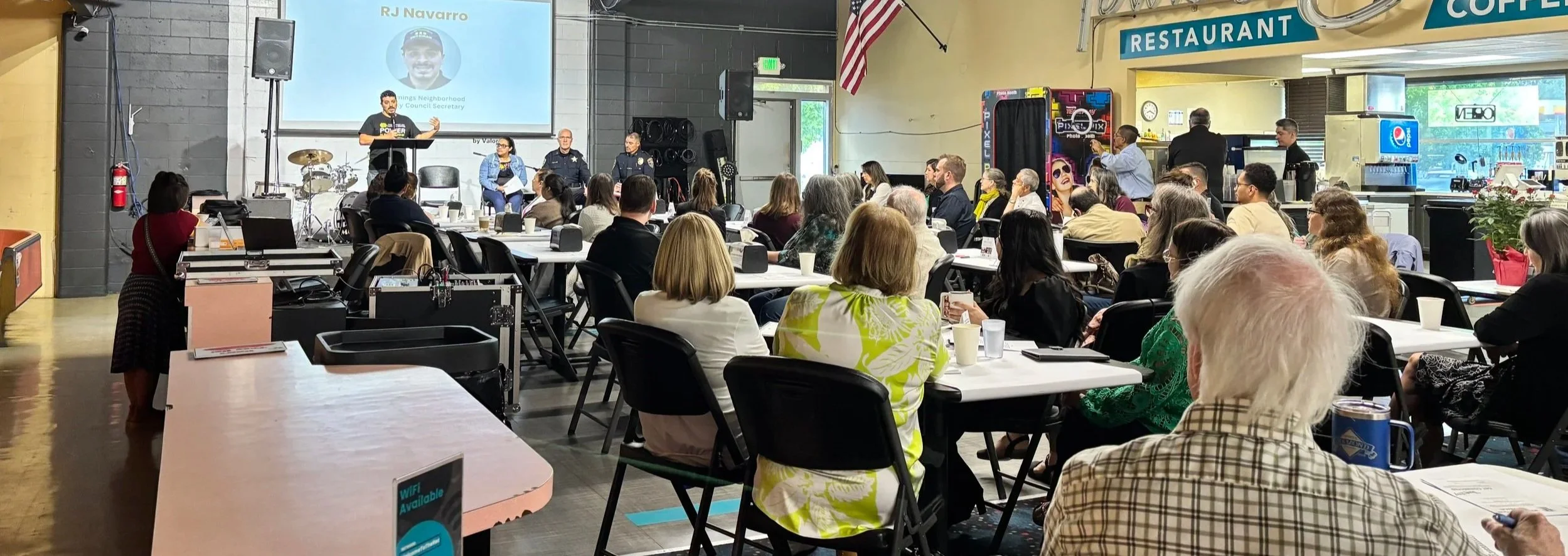
R.J. Navarro struggled as a young man and father with drug abuse and criminal behavior. “I remember hiding from the Keizer police in the attic of a friend with my three-year-old son,” Navarro said to a CBEL gathering in May. “I had very little respect for anybody, least of all the police. And I was teaching my son the same attitude with my actions.”
But the police surprised him. Navarro found them more understanding than he expected. “They gave me room to recognize my mistakes and make amends.”
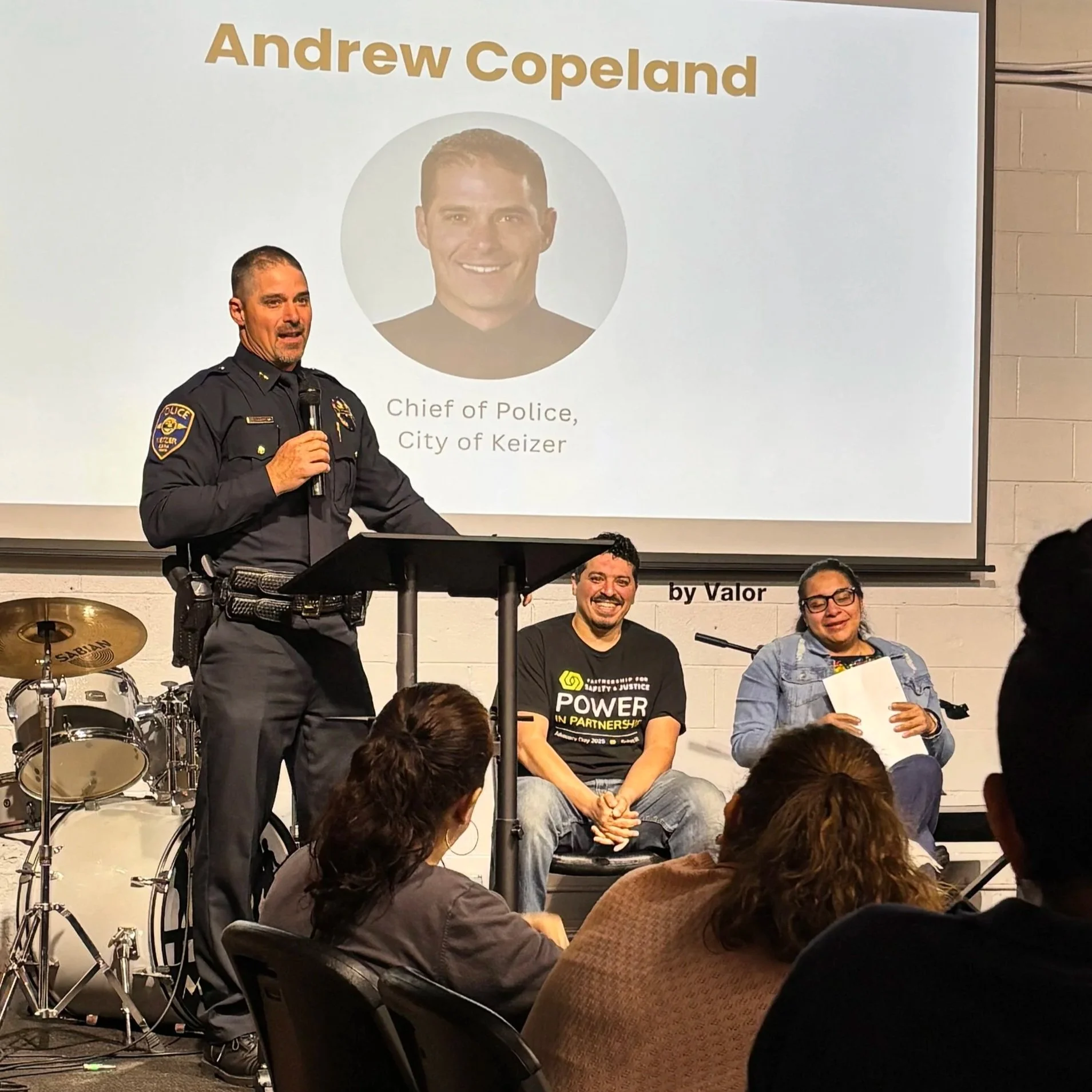
Keizer Police Chief Andrew Copeland, who spoke after Navarro, said that police culture continues to evolve. “When I was hired, we were trained to respond, make arrests and move on to the next call,” he said. “These days, we’re also committed to the before and after, the prevention and trust building necessary to build relationships and reduce crime.”
Salem Police Chief Trevor Womack echoed Copeland’s comment when he said, “We’re trying to use a scalpel instead of a sledgehammer. Ideally, incarceration is our last decision, not our first.”
“Neighbors help create the conditions in which safety, health, education, and employment are more likely, and more available,” said Jim Seymour, who was moderating the discussion with a group of 50 people interested in community resiliency. “Building positive social connections and providing support in times of need reduces the incidence of criminal activity,” he continued. “That commitment leads quickly to better partnerships with local law enforcement.”
Maribel Calderon learned that firsthand, as her family rebounded after her son ran into trouble with the law. “Trust and support changed everything,” she said. “Trust built with the probation officer, how he worked with us to turn things around for my son, and the support of the Highland Neighborhood Family Council. It’s so important to know that people care and are ready to stand with you,” Calderon added.
Calderon, in addition to being the chairperson for the neighborhood council, is also the co-chair of a committee working with at-risk youth, part of the Community Violence Reduction Initiative. Last month, the committee brought together six young men and a handful of community resource people collaborating to provide alternatives to violence for the youth.
“We all told them in our own way that we care for them, we want them to be safe, and we’re willing to work beside them. While resources and employment were offered, it was also made clear that they will be held accountable for their actions…that there are consequences for staying on the path you’ve been on.”
Calderon also talked about the mother of a teenaged son, killed in a 2024 shooting at Salem’s Bush Park, who spoke candidly to the young men. “She told them, ‘I know your lives aren’t easy. I hope you understand that you’re getting a second chance here to choose a better life!’ And to their parents, she said, ‘As hard as it seems right now, remember that your son is still alive. Show him that you love him.’”
“And, all the young men said ‘Yes’ to the invitation,” Calderon said. “The group of them, who were distrustful of each other at the start, asked clarifying questions of the police chief and other adults. They opened up, began smiling, and helped one another with job applications.”
“When families are strong, the children feel safe,” she reminded the CBEL gathering. “When families are strong, violence in the community goes down.”

R.J. Navarro’s path to clean living took years, and he thanked the people along the way who supported his journey. A founding member of the Cummings Neighborhood Family Council, R.J.’s lived experience now provides a link to others who have experienced war, addiction and street violence. In addition to parenting his children, he also volunteers on the Cherriot’s board, helps veterans find support and housing, and sits on the state Criminal Justice Commission.
Both police chiefs, looking at Navarro but speaking to the crowd, said in their own way, “R.J.’s experience is no longer the exception. Collaborative efforts like these are creating healthy neighborhoods, stronger families and more opportunities for young people to live peaceful, meaningful, productive lives.”