
Can the wisdom of early American democracy help us turn the K-curve in Salem-Keizer?
By Jim Seymour, with editorial assistance from ChatGPT
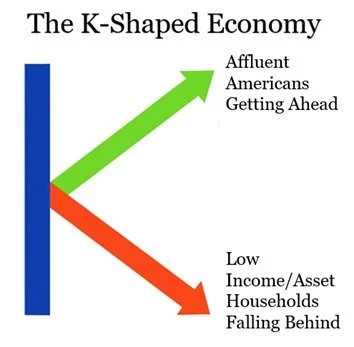
Economists sometimes describe America's growing economic divide as a K-shaped economy. The upper arm of the K represents those whose wealth and economic opportunities are expanding, while the lower arm represents families struggling to keep up or falling further behind.
The K-curve is a useful metaphor, even though economic trends are more complicated than a single image suggests. It raises an important question: What kind of future are we creating for families in Salem-Keizer, and can we change its direction?
An American Tradition Worth Rediscovering
Nearly 200 years ago, French political thinker Alexis de Tocqueville traveled across America to study its young democracy. In Democracy in America, he observed something remarkable: Americans had developed the habit of forming voluntary associations to solve problems, pursue opportunities, and improve their communities.
Rather than waiting for government or wealthy benefactors to act, ordinary citizens organized themselves. Tocqueville considered this art of association one of the great strengths of American democracy. He understood that democracy depended not only on elections and government institutions, but also on citizens learning to work together for the common good.
That tradition continues through America's nonprofit organizations. Our 501(c)(3) public charities provide a modern legal framework through which citizens can organize, pool resources, and pursue shared purposes. CBEL is one expression of that tradition.
Why Relationships, Housing, and Education Matter
Harvard economist Edward Glaeser's research helps illuminate the importance of social capital—the relationships, trust, and networks that connect people. His work on cities and entrepreneurship also demonstrates the importance of education and local economic conditions in creating opportunity.
These insights suggest that strong communities depend on more than financial investment. People need opportunities to build trusting relationships, exchange ideas, develop businesses, and work together. Feeling safe and respected makes participation in community life more possible.
Housing security is equally important. Stable housing provides families with a foundation for well-being, while affordable homeownership can create opportunities to build wealth across generations.
Education offers another pathway to opportunity. When parents and educators work together to ensure that every child receives an excellent education, children growing up in poverty have a better chance of achieving economic independence.
Strong social connections, housing stability, and educational opportunity are complementary building blocks of thriving families and neighborhoods.
Turning the Curve in Salem-Keizer
What happens if economic opportunity becomes increasingly unequal, affordable housing remains out of reach, and children enter school without the support they need to succeed?
The future could bring greater economic insecurity, weaker neighborhoods, and fewer opportunities for the next generation.
But that future is not inevitable.
CBEL's Neighborhood Family Councils offer a practical opportunity to rediscover the art of association. Neighbors come together to build trusting relationships, identify shared concerns, establish priorities, and work with schools, businesses, government, and community organizations to improve their neighborhoods.
These Councils are not simply another program delivering services to families. They provide a means through which neighbors can exercise leadership and take shared responsibility for the future of their communities.
CBEL's role is to nurture and support this capacity—not to decide for neighborhoods what they need, but to help residents develop the relationships, resources, and partnerships necessary to accomplish what matters most to them.
Imagine Salem-Keizer neighborhoods where families feel safe and respected, housing is stable, homeownership is attainable, children arrive at school ready to learn, and neighbors know and support one another.
That is the future CBEL seeks to help create.
A Question for the CBEL Board
Tocqueville recognized that Americans learned the art of democracy by practicing it together. Nearly two centuries later, that insight remains relevant.
As Board members, our responsibility is not simply to ensure that CBEL operates effectively. It is to ensure that our organization contributes to meaningful, lasting improvements in the lives of families and neighborhoods.
We must ask whether our work is strengthening the capacity of residents to shape their own futures and whether the conditions that matter most to families are actually improving.
Are we merely building an effective nonprofit organization, or are we helping build neighborhoods capable of shaping and improving their own futures?
Our answer may determine whether CBEL simply responds to the challenges represented by the K-curve—or helps turn that curve toward greater opportunity, security, and shared prosperity.
Sources and Further Reading
Alexis de Tocqueville, Democracy in America (1840), Volume II, Part II, Chapter 5, “Of the Use Which the Americans Make of Public Associations in Civil Life.”
Edward L. Glaeser et al., “What Is Social Capital? The Determinants of Trust and Trustworthiness,” National Bureau of Economic Research, Working Paper 7216 (1999).
Edward L. Glaeser, “Entrepreneurship and the City,” National Bureau of Economic Research, Working Paper 13551 (2007).
Jeff Horwich, “Have U.S. Consumers Gone ‘K-Shaped’? A Review of the Data,” Federal Reserve Bank of Minneapolis (2026).