
When Community Chooses to Come Together
In November, more than 700 children, parents, educators, and Salem Police Officers gathered in the gymnasium at Washington Elementary School for a Halloween & Day of the Dead Celebration. Laughter, excitement, and the simple joy of children and families enjoying time together filled the room. Members of the Washington and Hallman Northgate Councils came together for their third year to show what effective collaboration across neighborhoods and schools looks like.
It would be easy to see this as just another successful neighborhood event. But I believe something much more important was happening.
For six years, CBEL has been investing in building relationships among grassroots neighborhood leaders and the leaders of our community's institutions—schools, law enforcement, local government, and community organizations. We believe trust, built through shared experiences and sustained relationships, creates the social cohesion that can become social capital: the capacity to work together to accomplish what people could never achieve alone.
What happened at Washington Elementary expressed that investment.
And it happened at a particularly difficult time.
Our school district is considering closing six elementary schools, creating uncertainty for families and neighborhoods. Immigration enforcement activities have brought fear to many Hispanic families and increased tensions across our community. The tragic shooting that took the lives of three children and a teacher at an elementary school in Bend feels painfully close to home. Meanwhile, the constant stream of conflicting and often inflammatory political messages makes it increasingly difficult for neighbors to trust one another.
These are precisely the circumstances in which communities can begin to pull apart.
Yet something different is happening in our neighborhoods.
Recently, 35 grassroots leaders serving on CBEL's seven Neighborhood Family Councils came together and unanimously reaffirmed their commitment to their shared vision:
Every child grows up in a safe, stable, nurturing home, enjoys good health, succeeds in school, and goes on in life to become financially self-sufficient.
They recognized that the challenges facing our community are real and that people will have different opinions about how to respond. But they also recognized that their greatest contribution is to remain focused on what they share: a commitment to the well-being of children and families. Before leaving their gathering, these 35 community leaders unanimously agreed to support families that may be affected if their schools close.
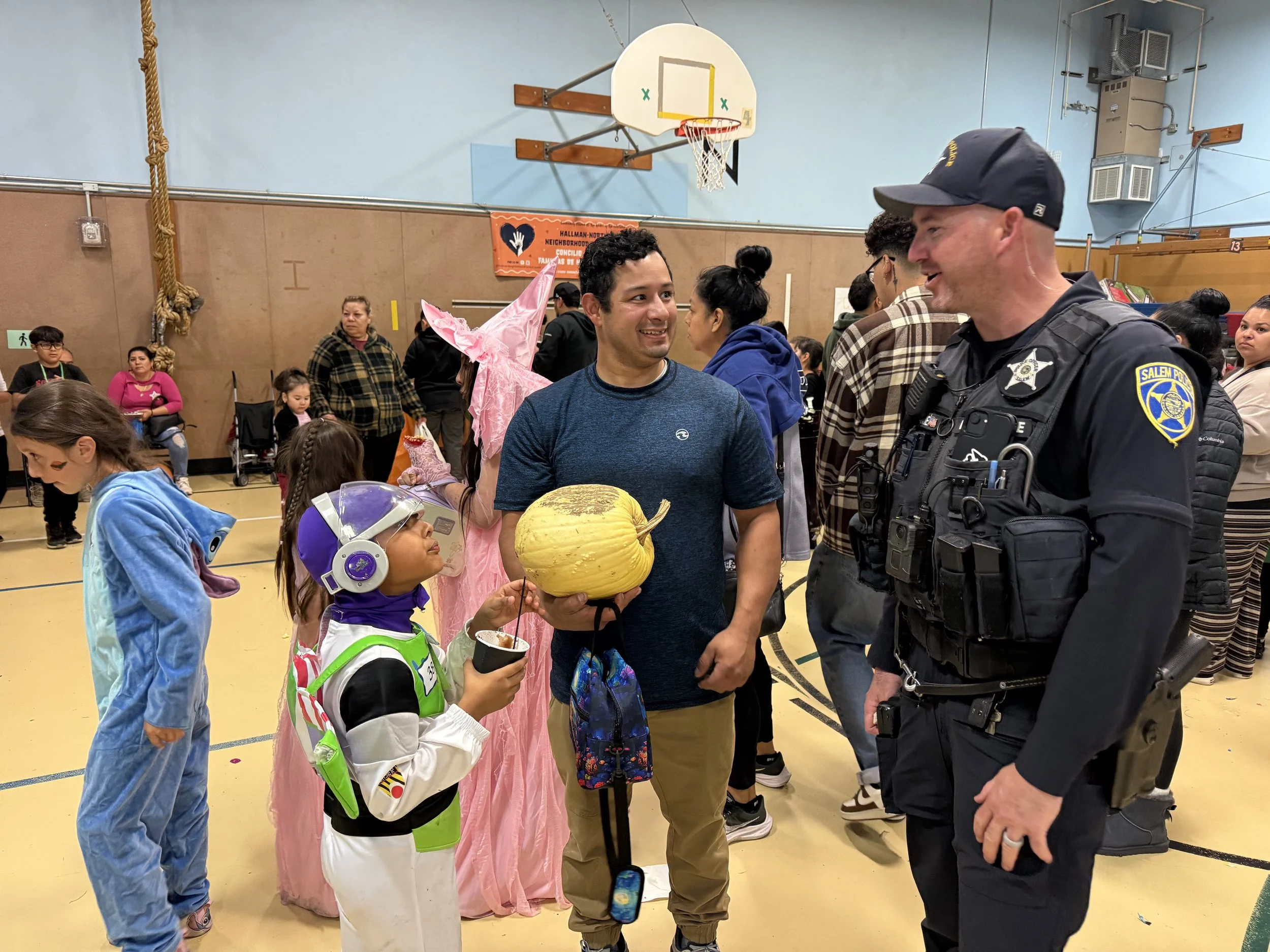
The Washington & Hallman Northgate Councils’ decision to move forward with the Halloween & Day of the Dead Celebration, with Salem Police Officers welcomed as invited participants, was a practical expression of that commitment.
Parents, educators, police officers, and neighborhood leaders were not gathered to debate their differences. They were there because they recognized that they share responsibility for creating a community in which children feel safe, valued, and connected.
To build on the growing community trust, Waldo Middle School’s 30-member Mariachi Band was the event’s main attraction.
And the children were watching.
They saw adults from different backgrounds and institutions enjoying one another's company, cooperating, and showing that differences do not have to become divisions.
This is how emotional intelligence becomes a community practice. It is how trust grows. It is how children learn, through the example of adults, what it means to belong to a community.
It is also how neighborhoods begin to develop the resilience to face challenges together.
For those of us entrusted with governing CBEL, this offers an important lesson.
Our responsibility is not simply to oversee programs or celebrate activities. It is to remain focused on the results we exist to achieve. In the language of Policy Governance, these are our Ends.
The Halloween celebration was an activity—a means toward an end. The deeper result we seek is a community where trusting relationships enable families, schools, public institutions, and neighbors to work together for children's well-being.
We should not confuse one successful event with proof that we have accomplished our mission. But we should recognize it as encouraging evidence that the relationships we have been cultivating are taking root.
Our mission is to build community resilience that strengthens families and supports world-class education, one neighborhood at a time.
CBEL alone will not accomplish that mission. Residents and institutions will accomplish it by trusting one another more, accepting shared responsibility, and acting together for the common good.
I am deeply grateful to the Neighborhood Family Council leaders, parents, educators, police officers, and community partners who continue to make this possible.
At a time when so much seems to be pulling people apart, they are showing us what it looks like to come together.
And perhaps the most important thing we are building is not a program or an event, but a community in which people have learned to trust one another enough to shape their future together.